01 Background
Inspiration
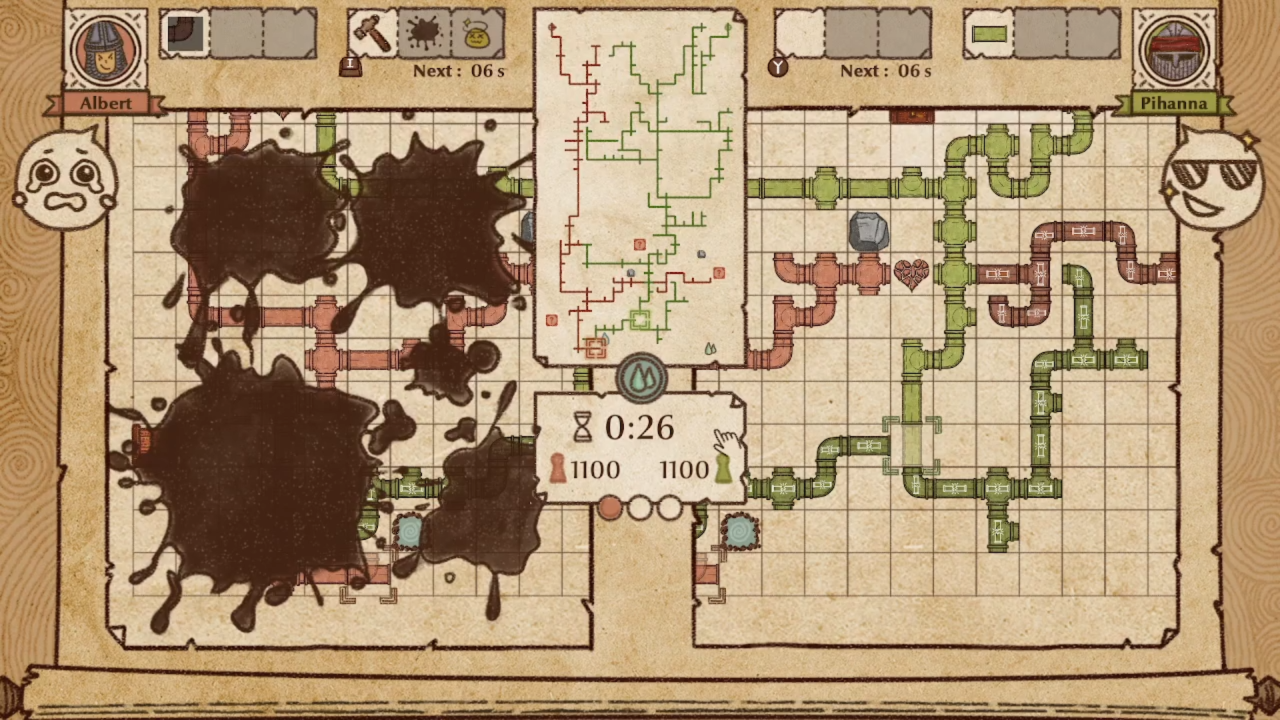
- Fulfillment of pipes linked (It feels visually comfortable!)
- Thrillment of party game (Friends make games more exciting!)
- Medieval parchment art (Unlike-game art style is immersive.)
Target Player
Players with moderate action-game proficiency and experience in casual competitive games. We made a questionnaire and filtered 6 players to be our core target players. They have average 3 months of casual competitive game experience, like Fall Guys and Crazy Arcade and frequently engage in local co-op games like Overcooked and It Takes Two.
Story Background
After a long drought, the Alimair region suffers from a shortage of water and dry riverbeds. This led to fierce battles between Agamemnon and Hector fighting to seize the water from the collapsed ground.
02 Gameplay
Core Rules
1. Goal: Build pipes to get water as much as possible within 5mins.
2. Player Abilities:
- Build pipes (You can rotate pipes before build.)
- Dismantle pipes (But only do to your own pipes.)
- Use prop (To interfere rivals and protect yourself.)
3. Building Rules:
- Start Point (Build from start instead of anywhere.)
- Disconnected (Pipes will be invalid if disconnected from the start.)
- Reconnect (Build in break point to reconnect pipes.)
Core Experiences
1. Building pipes smoothly and intuitively
- Random pipes & high time pressure provide a highly stimulating experience with fast operations and quick-thinking layouts.
- Smooth linked pipes provide a comfortable visual and psychological experience.
2. The Thrill of Player Interaction
Racing pressure and various ways to make trouble provides an intense and thrilling competitive experience.
03 Design Process
Step1: Paper Prototypes - By building & playing mini board prototype, we verified the fun of connecting pipes.
Step2: Video Prototypes - We repeatedly made demos and tested them with 6 core players, detecting problems: P1 To make building smooth and intuitive, P2 To promote interaction, P3 To improve falling players experiences.
Step3: Broader Testing - We made survey questionnaire & interview to gather feedbacks from 14 players: P4 To build Rhythmic levels, P5 To Help Train.
P1 To make building smooth and intuitive
1. Smooth in Action: Improve hand feeling and rhythm
i. Set appropriate cooling down time: We set the cooling time to 0.5s to reduce the skill gap between experienced and average players.
ii. Adaptive rotation: Pipes now automatically rotate to connect.
2. Intuitive in thinking: Only requires a little bit of thinking
i. Set weights of different pipe types: Each pipe type makes a different path, which affects how players plan.
ii. Future Pipes Provides thinking sets: Our solution is to show three upcoming pipes, which only change after all are used. This lets players plan easily without feeling overwhelmed.
P2 To promote interaction
1. Optimize Connecting Pipe Rules
i. Take over disconnected pipes? NO! By changing the rule so disconnected pipes stay with their original owner, we improved the competition.
ii. Kiss Pipes: The new rule changes the kissed pipe into "ruins," a broken piece only its owner can remove.
2. Prop System
i. Added more props: We enriched props to 15 but kept those that are easy-to-use and have clear impact.
ii. Limited-time refresh treasure box: Players can build to seize these boxes to interfere with rivals and get water goals quicker.
P3 To improve falling players experiences
1. Win Condition: From Single Race to Dynamic Rounds - Players now try to capture water sources before time runs out, making the game faster and giving more chances to catch up.
2. Dynamic Prop Balancing for Fair Play - Falling players have easier and more effective props to use, such as bomb, dizzy, and ink. Advantaged players receive interference props that require more strategic thinking.
P4 To build Rhythmic levels
1. Multiple and Dynamic Water Goals - Generated 2 water goals when the game starts. New water goals appear after all the water sources are either collected or gone.
2. Prop delivery time interval - The intervals change based on the total game time, which helps build rhythmic levels.
3. Map scale (35*21) - The map's width has been reduced to let players meet earlier.
P5 To Help Train
1. Multiple Levels of AI combat - Easy, Normal, and Hard AI difficulty levels.
2. Add Best-of N games (BO1/BO3/BO5) - Give everyone more chances to get familiar with the game and to win!
3. Add Guide Book and Hint Button - We tried to make a clear combat guide and put effort into structuring the points.
04 Immersive Art Design
Story Background & Avatar: Choose Name and Profile; Winning Hymm. Animation Feedback. Hummer Emoji.
05 Feedback
When we conduct user research, we collect plenty of feedback. Some help us discover and solve problems, while others strengthen our confidence.
Common Rate: 4.42/5 (N=14) There is a big surprise that greatly exceeds expectations.
Interesting mechanism! Its simple but elegant!
Love this art! It feels so immersive!
Really enjoy the moments making trouble!